




ASC 5411LN / ASC 5415LN Capacitive Accelerometer
Triaxial MEMS acceleration sensor for usage in a low frequency response up from 0Hz


Key features
- Triaxial accelerometer
- MEMS Capacitive
- Measurement Range: ±2 to ±400 g
- Noise Density: 7 to 400 µg/√Hz
- Frequency Range (±5 %): DC to 2000 Hz
- Aluminum or Stainless-Steel Housing
- Made in Germany
- Very Low Noise Differential Voltage Output
- DC Response, Gas damped
- High Shock Resistance
- Excellent Offset and Scale Factor Stability
About the ASC 5411LN / ASC 5415LN Capacitive Accelerometer
The accelerometers of type ASC 5411LN and ASC 5415LN are based on proven MEMS technology and capacitive operating principle. The integrated electronic circuitry enables a differential analog voltage output (±4 V FSO) and flexible power supply voltage from 6 to 40 VDC. The LN (Low Noise) accelerometers from ASC provide an outstanding noise performance from 7 to 400 µg/√Hz which is essential for demanding measurements of smallest frequencies and amplitudes.
The sensor ASC 5411LN features a lightweight aluminum housing and the sensor ASC 5415LN provides a robust stainless-steel housing, both with protection class IP65 and an integrated cable with configurable length and connectors.
The triaxial accelerometers enable the detection of smallest acceleration amplitudes in three degrees of freedom, for example for measuring aerodynamic and mass-related imbalances in wind turbines or for evaluation ride comfort in passenger ships.
Options ASC 5411LN / ASC 5415LN
- Customised Cable Length
- Customised Connector
- TEDS Module
Applications ASC 5411LN / ASC 5415LN
- NVH and Operational Stability
- Driving and Ride Comfort Tests
- Vehicle and Running Dynamics
- Specifications
- Datasheets


Related products


Related services
/ 2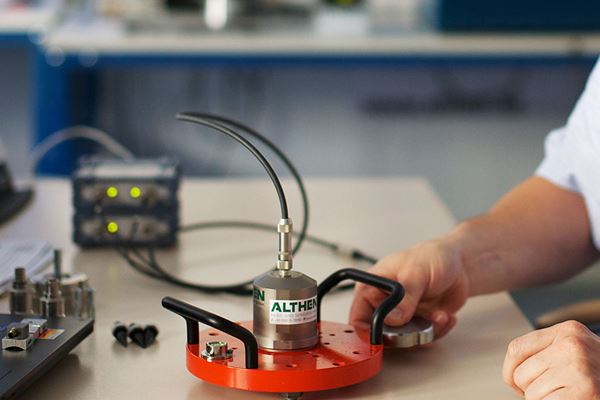
Calibration
Take advantage of our calibration technology – for new purchases as well as existing equipment. Regular calibration by Althen ensures that your sensors and testing equipment are working accurately. This is the only way to get meaningful, correct results over the long run.